The situation
EXOR Oceania was developing Industrial IoT and edge solutions for mining and resources. The opportunity was not simply to demonstrate hardware or connect another device.
The challenge was to create a credible path from an Industry 4.0 technology proposition to a solution that could operate in a demanding mining environment.
That required more than a product. It required the right use case, the right technical support, a delivery ecosystem, funding for early technical work, and a route from demonstration to proof of concept and deployment.
The challenge
Industrial technology projects often stall between a promising demonstration and real operational use. In this case, the work required alignment across several moving parts:
- The operational mining use case and the customer problem to be solved;
- Relevant Intel IoT technical stakeholders in the United States;
- EXOR Oceania’s industrial-automation and edge-technology capabilities;
- Systems-integration support;
- Research and demonstration partners;
- Funding for technical training and an initial proof of concept; and
- A practical pathway from technical validation to mine-site deployment.
No single partner could carry the programme alone.
My role
During my role at Intel, I initiated and developed the collaboration with Carlo Sportiello and the EXOR Oceania team. I worked to understand the project and its operational context, then mapped the internal and external stakeholders needed to support it. My contribution included:
- Clarifying the opportunity and the project pathway with EXOR;
- Activating relevant Intel IoT technical stakeholders and support;
- Bringing the systems-integration and research ecosystem into the programme;
- Securing support for initial technical training and the proof of concept;
- Delivering training on Intel technology; and
- Helping keep the partner ecosystem aligned as the work progressed from collaboration to technical validation and deployment.
The role was not to replace the technical specialists or the implementation partner. It was to create the conditions in which the right technical, commercial and ecosystem pieces could move together.
The outcome
The initiative progressed from a partner collaboration and initial technical enablement to a proof of concept and deployment in Australian gold-mine operations.
The value was not only in one solution. It was in building the delivery path:
- Operational mining use case
- Technical stakeholder mapping
- Training and sponsored proof of concept
- Systems-integration, research and test-ecosystem alignment
- Mine-site deployment
That is what helps an industrial technology initiative move beyond a promising demo and into a working environment.
Partner perspective
“I had the pleasure to work with Natalia on a few occasions. As a partner company, we developed Edge Solutions for Automation in mining and resources. Natalia played a massive part in providing support via technical teams and sponsorship on this journey. The few projects we worked on were always managed in the most efficient manner. I found Natalia a key team player and a professional across all business facets.”
What this proves
Technology adoption in industrial environments rarely fails because the technology is uninteresting.
It fails because the customer problem, technical enablement, partner ecosystem, funding path and route to deployment never become one coordinated programme.
Public project activity
The EXOR Oceania collaboration was publicly documented through industry events, demonstrations and partner posts, including activity around the Digitization in Mining conference in Adelaide, UWA’s Industry 4.0 ERDi Test Lab, IMARC and the Perth IICA Tech Expo.
- Digitization in Mining conference, Adelaide, November 2022. Carlo Sportiello and I presented the industrial-automation-in-mining solution, based on Intel FPGA technology, in a tandem speech.
- Perth IICA Tech Expo. EXOR Oceania’s public post describes the collaboration with UWA’s Industry 4.0 Energy & Resources Digital Interoperability (ERDi) Test Lab and me, working on Smarter Fleet Management and Operator Interaction using EXOR’s edge technologies and open-source solutions, with current progress shown at the expo.
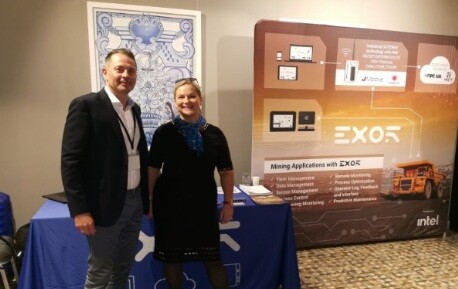
Work delivered during Natalia Poliakova’s role at Intel Corporation, in collaboration with EXOR Oceania and project partners.
Have a complex industrial, AI or deep-tech solution that needs the right customer path, technical ecosystem and proof-of-value plan?
I help founders and technology teams turn a fragmented opportunity into a credible delivery path.
Book a project scoping call →